I submitted my education and experience requirements in Dec 2007. The letter from the board indicates 20 business days (aka a month) of processing time. I called the Board to ask if this is 20 days from when they got it or 20 days from 15 January 2008 (the date on the letter they sent us). I was told, 15 January. You think the wait ends then. Nope. I was told that assuming those documents are in good order, then they will request a background check from FINRA/SEC which could take 4-6 weeks. So here is the time line. By 15 February you should know if your education/experience requirements are completed. Then around mid to late March your background check should be complete. Wow.. is that crazy or what? For those of you with your CFP, was the turnaround from exam pass notification this slow? Patience is a virtue that I hate to harvest…
I’m going to list my experience as a guide to others looking for more information on how long the official certification process may take.
Since I bought a new webcam (the Logitech QuickCam Pro 9000), I’m going through the learning process of using it. I’ve used Gmail video chat, downloaded Skype, and now I’m posting my first vlog here at FPPad.com.
Check it out below and let me know what you think (be kind!)
Disclaimer: No company productivity was harmed during the making of this film. This is totally a personal endeavor; besides, I was the first one in the office this morning!
For those firms who derive revenue from assets under management (AUM), revenues are down anywhere from 20 to 40 percent year over year. In response, financial advisers are evaluating all available options to trim operating costs. Undoubtedly, salary cost is the biggest line item expense for independent advisory firms.

That said, layoffs are often the method of choice to reduce this significant expense. However, there are other, more cost-effective ways to reduce labor costs.
One of my goals to kick off 2009 (which I have yet to write about!) is to work on using Outlook more effectively and efficiently.

I previously wrote about optimizing your Outlook habits by only using the program at three specific times during your workday (say, 10am, noon, and 4pm or whatever you find works in your schedule).
Today, I’m happy to report that since the beginning of 2009, I have worked on eliminating all the pending emails in my Outlook Inbox so I can reach the ultimate goal of Inbox Zero. Here’s what my inbox looks like today:
Andrew listed many comments from advisers that feature all sorts of strategies and ideas. It’s a lengthy list, and I must admit, I didn’t get a sense of what the majority of respondents were doing.
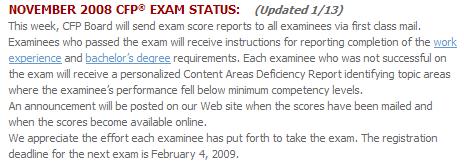
For those of you wondering when to expect to receive your November CFP® Certification Examination results, CFP Board mailed them yesterday, January 13. See the note from their website:
I apologize for the infrequent updates lately to FPPad. So what’s been keeping me so busy in the last few weeks?

The end of a calendar year is especially busy for most independent wealth management firms, and ours is no exception. Between closing the books, communicating quarterly estimated tax payment information, creating client reports, and calculating fees, there are lots of processes and procedures to follow to ensure that nothing falls through the cracks.
I recently learned about a recent IRS Revenue Procedure from one of our custodians. The document is Revenue Procedure 2008-68 and addresses the concern REITs (Real Estate Investment Trusts) have regarding their ability to satisfy the taxable income distribution requirements.

A REIT is required to distribute 90% of its taxable income, including any net capital gains, to its shareholders each year. If it fails to do so, the REIT may lose its ability to reduce or eliminate its corporate income taxes. Due to the credit crisis affecting the economy, REITs are struggling to raise enough capital in order to distribute the mandatory 90% of taxable income in cash.
As a result of the procedure, the IRS will now allow REITs to distribute stock, in addition to cash, as a dividend and the entire amount will be treated as satisfying the REIT distribution requirements.
Thanks to one of my readers, Bob, for reminding me about potential security issues that don’t receive much attention in the financial adviser space.
If you’re using a standard (i.e. not Bluetooth) wireless keyboard in the office, anything you type is not secure. This includes all the Social Security Numbers, account numbers, birthdays, email addresses, etc. for your clients that you type day in and day out.
See this YouTube video featuring Steve Gibson of GRC.com addressing the ease at which wireless keyboards can be compromised.
Readers of FPPad.com know that we’re in a recession. Not very many needed the National Bureau of Economic Research to tell them that we’ve been in one since December 2007. While little can be done to cure the ills of the global economy, advisers can evaluate how their business is positioned in order to thrive in the face of economic pressures.

I want to comment about positioning a practice in a recession after reading David Drucker’s article on Morningstar Advisor, Practice Management in a Recession.
Drucker interviewed two broker-dealer firms to discover what their reps are doing to respond to the recession. What are they doing? First, reps are committed to continued spending on marketing to new clients, and second, they are looking to reduce operational inefficiencies in their practice.